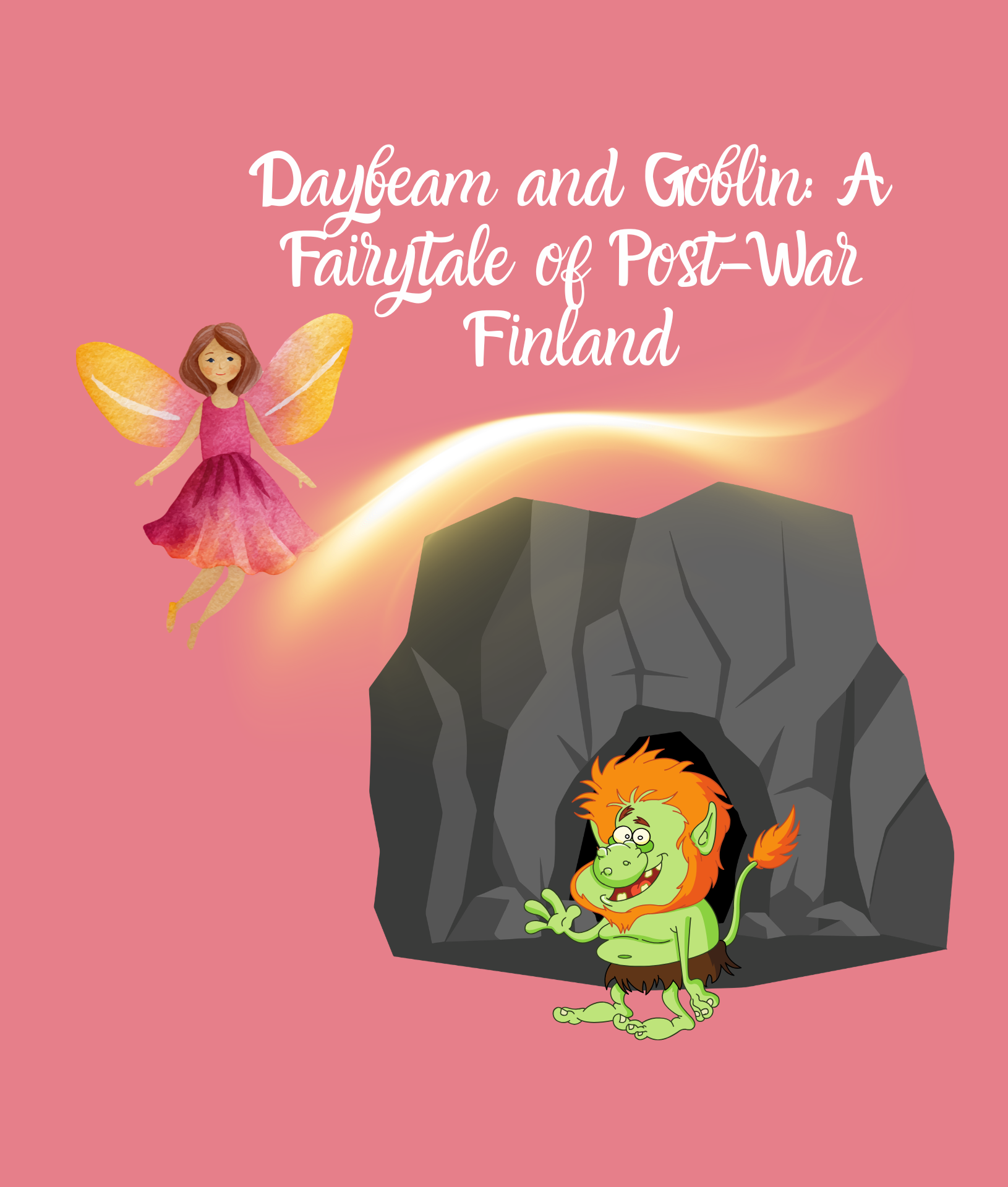
Description
Can a simple children’s fairy tale carry the collective trauma of a nation emerging from war?
In 1949, Finland hadn’t shaken off its shadows yet. The wars had ended, but their weight was still felt in the silences between people. It was into this atmosphere that Reino Helismaa released Päivänsäde ja Menninkäinen, the Daybeam and the Goblin, a song that dressed something very deep and emotional in the gentle clothes of a fairy tale.
On the surface, Päivänsäde ja Menninkäinen is a story about a Daybeam and a Goblin who can never quite reach each other—one a creature of light, the other bound to his dark cave. Satu reflects on this simpler level through her own experience of directing the story as a play for schoolchildren, where the Daybeam and the Goblin are seen purely as classic fairy-tale characters, met with innocent wonder. But if you look closer, the dialogue suggests the song may reveal something much deeper: a mix of sadness and hope within the fragile atmosphere of post-war Finland. It invites the listener to interpret the story as a reflection of a society divided between those trying to move forward and others still stuck in a darkness they can’t leave. As Satu poignantly suggests, the song captures an impossible encounter between different worlds: while the Daybeam likely never has to stand in a breadline, the Goblin is the one who calls those shadows—and that poverty—his home.
In this episode, Satu and Suvi explore these threads together with genuine curiosity. Is the Goblin simply melancholic, or is his cave a metaphor for the collective trauma that post-war Finns couldn’t yet openly name? Satu even jokingly wonders if the Daybeam arrives with a ”saviour complex”—acting like a therapist for someone who isn’t ready to be seen or ‘fixed.’ And when she finally flies away, the discussion turns to the bittersweet reality of their encounter: has she abandoned him, or simply had to let go when two worlds simply cannot coexist?
The conversation revolves around folklore and psychology, moving between the realities of the post-war era and the very Finnish habit of expressing the unspeakable through nature spirits. They also consider what it meant to be one of Helismaa’s “common people” in 1949: those carrying invisible weight of the past—the silent veterans, the displaced families, and the ones left in the shadows of poverty while the rest of the country was busy rebuilding.
The package includes an audio recording, a full transcript, a Finnish–English vocabulary list, multiple-choice questions, and a complete answer key. As an extra, this package also includes a supplementary background text in Finnish providing a cultural & historical introduction to Reino Helismaa and the 1949 post-war context of the song. This reading material is accompanied by a dedicated ”Key Words” glossary to help you master the high-level vocabulary used in historical analysis. This Finnish listening exercise lasts approximately 42 minutes and features a dialogue between two speakers – Satu and an interviewer – using natural Southern Finnish (Helsinki region & surroundings) speech patterns. This episode is best suited for advanced Finnish learners at B2-C1+ level. The audio includes extended storytelling combined with deeply reflective and abstract topics (post-war trauma, psychological archetypes, and societal shift), which increase the overall difficulty. C1 learners will find this a perfect exercise for refining their ability to follow nuanced debate on psychology, sociology, and Finnish history in real time. While the main storyline is accessible, the rapid shifts in perspective and the sophisticated vocabulary (related to collective trauma, savior complexes, and social stratification) mean that B2 students will likely rely heavily on the transcript and glossary. It is an excellent “stretch” exercise for those looking to bridge the gap between intermediate and advanced Finnish.
__________________________________________________
Please note!
-
Digital Product Policy: Due to the nature of digital content, all sales are final. By purchasing, you agree to immediate access and waive your 14-day right of withdrawal.
-
License: Your purchase includes a non-transferable license for personal use only (individual learning or private study).
-
Commercial Use: If you are a teacher, school, or institution and wish to use this material in a classroom or commercial setting, a separate license is required. Please contact us at info@karpasenakatossa.com for commercial licensing options.
-
Technical Support: If you encounter any issues with your download, we’re here to help! Reach out within 7 days of purchase.
Full Terms of Use can be found here: https://www.karpasenakatossa.com/terms-of-use/




Reviews
There are no reviews yet.